Will Your Tent Fit the Campsite Pad?
Measure the space your tent needs with the fly and stakes, then check what the campground listing actually includes.
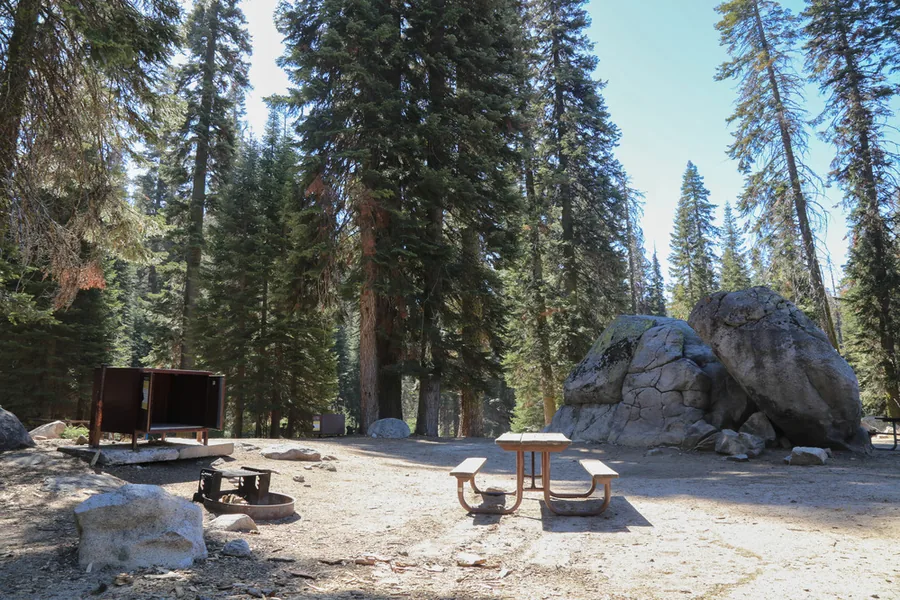
Before booking, compare the fully pitched tent with the clear, level part of the tent pad. Include the stakes, rainfly and vestibule, the covered space outside the tent door. A tent with a 10-by-9-foot floor could need 12 by 14 feet once it’s staked out. That setup would outgrow a 12-by-12-foot pad in either straight orientation.
Measure the tent with the rainfly on
Pitch the tent at home or somewhere you have room to set it up as directed. Extend the vestibules you plan to use and stake out the fly and guylines according to your model’s instructions. Guylines are the cords that run from the tent or fly to anchors outside it.
- Start with the tent body. Measure its width and depth along the ground. Mark the door on a quick sketch.
- Measure each side separately. From the left, right, front and back edges, measure horizontally and straight out to the farthest point the fly, vestibule or anchor reaches on that side. If a stake holds out the vestibule, measure to the farthest point once.
- Write down the full dimensions. Add the left and right extensions to the width. Add the front and back extensions to the depth. Mark where you need stakeable ground and where you’ll stand to use the door.
REI’s tent setup guide explains how to practice pitching with the fly and guylines. If you can’t do a trial pitch, ask the tent maker for the full dimensions with the required anchors in place. If all you have is the floor size and the pad looks tight, wait for better measurements before booking.
Try the tent both ways on the pad
Say the tent body is 10 feet wide and 9 feet deep. Its farthest points are 1 foot beyond each side, 1 foot behind it and 4 feet from the front wall to the front stake. That makes the pitch 12 feet wide by 14 feet deep. These are example measurements. Use your own for booking.
- 12 × 12 feet: The 14-foot side is 2 feet too long. Turning the tent a quarter-turn gives you the same 12 feet. Look for a larger pad.
- 12 × 15 feet: The dimensions line up with 1 foot total left over along the length and no spare width. Ask about the clear edges and anchor positions before booking.
- 14 × 16 feet: There are 2 extra feet across each dimension in this orientation. Check where the door faces and whether you can use the planned anchor locations.
Match the two dimensions in one orientation, then try swapping them. A narrow space at one end of a crooked pad can still be a problem even if the listing shows enough room on paper. Keep the tent entrance and the path back to the car clear when you turn the layout.
Check what the campground includes in its measurements
Look up the exact site number. The parking space and the tent pad can have separate dimensions. At Zion’s Watchman Campground, the listing for site D012 gives 32 × 28 feet for the tent pad and 19 × 15 feet for the site length and width associated with the parking spur. The listing says the pad measurement includes the fire ring and picnic table. Use the listing dimensions alongside the site photos and any actual clearance the campground can confirm.
At Watchman, Zion directs campers to pitch tents on constructed pads. Its camping regulations keep tent stakes and guy ropes inside the campsite boundary and prohibit attaching them to trees or structures. Ask the campground what anchors are allowed if the pad is bordered, raised or too hard to accept the stakes your tent uses.
What to ask before you book
Give the campground the site number and your pitched measurements, including the part that sticks out farthest. Here’s a way to ask:
For site D012, is there one clear, level rectangle at least 12 by 14 feet, with room to reach the front door? That size includes my fly and stakes. What is the pad surface, and where can I place my stakes?
If staff can confirm the space, anchors and door access, save the site number and your pitch dimensions with your reservation. Use the weekend packing checklist for the rest of your gear. If the only way to squeeze in is to skip a required anchor or put the door against an obstacle, pick another site.